Many campaigns have been formed that focus on global warming. In this article the campaigners have become a bit more creative in their approach to their protest and focused on the number 350. This number means that "if the gas concentration exceeds 350 for long, they warn, the world can expect decades of disrupted climate patterns, rising sea levels, drought and famine."
The Earth is going to diminish slowly and we are obviously going to go down with it. There are many things that have been killing this planet, and carbon emissions is one form. Trees are important in reducing carbon emissions, yet many trees are being cut every day. I think people hesitate in making a sacrifice because they do not want to change their lifestyles. I do not understand why saving the environment would not be on every one's list of "Things to Do."
Tuesday, October 27, 2009


Monday, October 26, 2009
$105 million was ordered from Exxon to NYC
Summary: A 105 million dollar punishemnt fee was ordered by a federal jury from Exxon to NYC. The fine was ordered to treat the gasoline addctive that can contaiminate the undergroud water in NYC. The addctive that NYC reported is methyl tertiary butyk ether, also know as MTBE, which is used to increase gasoline's octane level to reduce air pollution. Royal Dutch Shell, BP Plc, Chevron Corp, Citgo Petroleum Corp, Hess Corp and Sunoco Inc tried to settle a 15 million payment with NYC earlier. And Exxon is seeking for legal options now. It was a news posted Yahoo on Oct 19th. Please check orginal article here.
Commnets: This article reminded me aout the relationship between water and energy that Dr. Webber mentioned in his article. We always valued more about energy, since it might bring more profits in short term. But we mostly ignored the importance of water . We can't live without water, and there is no alternatives for that, but we can always invent alternative energy form. Specially, in this case, NYC is the most population intnesive area in the whole world, and rely mostly on underground water for its daily life. Pollution to the undergraoup water is extermely dangerous. So, I think those big oil company which have it all need think more about the side effects that energy exploring might bring, and think more about long-term effects. Moreover, we need to think the importance of water, and put that in the list of environmental protection, and maybe set an agency to control the water qualties.
Commnets: This article reminded me aout the relationship between water and energy that Dr. Webber mentioned in his article. We always valued more about energy, since it might bring more profits in short term. But we mostly ignored the importance of water . We can't live without water, and there is no alternatives for that, but we can always invent alternative energy form. Specially, in this case, NYC is the most population intnesive area in the whole world, and rely mostly on underground water for its daily life. Pollution to the undergraoup water is extermely dangerous. So, I think those big oil company which have it all need think more about the side effects that energy exploring might bring, and think more about long-term effects. Moreover, we need to think the importance of water, and put that in the list of environmental protection, and maybe set an agency to control the water qualties.
Sunday, October 25, 2009
China’s Bright Solar Outlook
China’s new solar energy policy is very lofty proposing to increase its solar capacity from 50 megawatts in 2008 to 10 to 20 gigawatts in 2020. This increase would be about 20 or 40 times the solar capacity of the U.S. in 2008 (eia). This increase is to be accomplished through government subsidies for solar power plants and rooftop instillations. The program “Golden Sun” will subsidize 50% for on-grid plants, and 70% for off-grid power systems. This program should generate 500MW of power and lasts until 2011.
China’s solar policy should be good for many global companies and consumers. Companies such as First Solar, Solarfun, Canadian Solar Inc., and Trina Solar all have agreements to start building facilities. First Solar, which is an Arizona based company, has an agreement to build a 2GW plant in Ordos City, which should be one of the largest in the world. This would probably be like The Three Gorges Dam of solar plants a.k.a. huge! This 2GW plant will not even be completed until 2019. Solarfun, a Chinese company, also has a contract to build 2 plants that will total 600MW of power for the city of Hohhot. Canadian Solar Inc. has a contract to build a 500MW plant for the city of Baotau. Trina Solar also has plans to increase its plant by 500MW.
This is all being done by solar companies because of China’s availability of capital and lower prices of polysilicon, which is the raw material to make thin-film solar cells. This is all a play by China to make Solar power technologies economical for production. Solarfun and Trina Solar are good examples of this. Solarfun has taken out a 56.8 million dollar loan to increase its capital for its 600MW plants. Trina Solar has taken out a 304 million dollar loan to increase its capital to fund its expansion of 500MW.
These loans and expansions of power and solar technologies should come back to benefit the consumer. The increased use of capital should help start the flow of money again and help us out of our current recession. The increased renewable energy capacity will help China reach its desired solar energy capacity and supply power to more of its cities. This is also helpful for the U.S. in order to see how the production of these solar plants function economically and efficiently before we construct more of our own. Finally the most important thing is to see if China can meet more of its energy demands with more solar and less with its coal plants!
(The lithium part of the article, which I am not commenting on, but will be very important for the next generation of batteries for electric cars, and storage of large amounts of power from utility scale wind or solar plants.)
Sources
U.S. Electric Net Summer Capacity. EIA, 01 July 2009. Web. 25 Oct. 2009.
Iowa Lakes Community College: Partnership for Academic and Economic Success in a Rapidly Evolving Wind-Energy Industry
Iowa Lakes Community College have demanded for a trained renewable energy workforce in order to reduce energy expenses. Their request for the program launched in 2004, since then it became a 2 year degree program for the studies of wind energy. Students join together and come up with a project involving wind energy. Most of their projects become a great use to the environment. Students work utilizing a 1.65 megawatts wind turbines as a laboratory. Their work has became a great help not only to the environment but also economically that America should "continue to pursue alternative energy resources and encourage citizens to pursue formal education in renewable energy." This program also pre-pairs students on becoming future technicians with high skills, great knowledge of wind energy. So far this Community College has became a success and hopes to grow and pass on to other schools.
Converting Carbon Chains Into Ethanol
Summary: The competition is on to produce biofuels without needing food crops. Many companies around the country are developing methods and refining methods to convert many viable resources into ethanol. The industry is working towards reaching the goals Congress set in 2007. They are running a little behind schedule due in part to lack of capital because of the credit crisis, but mostly because discovering the keys of how to successfully break the materials down in an economically feasible way is proving to be difficult. However, progress is being made, and around the country small plants testing different methods of biofuel production are springing up. There are a variety of ways being used to create biofuel (Coskata, a leader among the group, uses an 8,000 degree torch to convert wood chips into its base elements which are then fed upon by bacteria who secrete ethanol), and many companies are pursuing different routes hoping to claim the prize of creating the second generation of ethanol.
Comment: As the actual costs of creating these fuels begin to surface, we will have a better picture of what the energy profile in the future may look like. The forms of ethanol production these companies are pursuing are carbon neutral, and could be very beneficial to the environment. Scaling the prototype factories into larger, more economical sizes is the key, as Wesley J. Bolsen, Coskata’s chief marketing officer, says, “the question is how rapidly we can scale.” If we could start creating environmentally friendly, cost efficient fuels from garbage, construction and demolition waste, trees or special crops we would be moving in the right direction.
Daniel Gellerup
Oil Industry Sets a Brisk Pace of New Discoveries
Summary: Even though oil is harder to find nowadays, it is possible thanks to the technology that keeps on improving. This year, more than 200 oil discoveries have been made by big and small oil companies. This brings excitement for the industry as well as anxiety because of the fear that lower prices might injure the exploration. Companies are trying to keep up with the exploration while trying to reduce the costs. Thanks to this exploration drive companies have also found natural gas reserves and one of them could be Venezuela’s largest natural gas field.
Comment: We know that we need oil and people believe that there’s still a lot in the ground but it’s very expensive to explore and extract. It is reasonable that companies will explore more when the prices are high and that they won’t when the exploration is not worth the price. So, maybe there’s more oil left than we think, and the day when the price is high enough to explore the most difficult places will come.
Wednesday, October 21, 2009
California Tries to Solve Water Woes
Earth, also called Blue Planet cause of the huge amount of water it has. Even if we want to see it or not it is becoming less and less blue every day. Depending on the part of the planet this is becoming a small, normal, big or huge problem.
In this case we do not need to look very far to find one of those problems, right here in the state of California. It should be a reason to worry about, but as usual it is turning into political stuff, the typical argument between Republicans and Democrats, but in this case both supporting the same goal, to solve the problem about the water supply.
The main idea is to repair the state’s fragile water ecosystem, to unleash new water supplies and to increase water conservation throughout the state. More specifically, negotiators hope to seal a deal that would make equal the goals of restoring the Sacramento-San Joaquin River Delta ( a collection of channels, natural habitats and islands at the confluence of the Sacramento and San Joaquin Rivers that is a major source of the state’s drinking water) and increasing the supply of water to residents, businesses and farms. Being the first one the largest environmental restoration project ever in the United States.
The discussion over how to distribute the water in California is decades old, but when it comes to water legislation, close to done never means done. There are many consequences cause of this problem with water, like water restrictions and increased prices for water, a federal order last year forcing water authorities to curtail the use of large pumps in the Sacramento-San Joaquin Delta to help preserve dying smelt has reduced water flows to agriculture, environmental problems in the Sacramento River have resulted in a collapse of the Chinook salmon population…
Of course there are some proposals to fix this. The construction of at least one dam is included in the plan, as well as a peripheral canal that would transport water from the Sacramento River around the delta to federal and state aqueducts for use in urban and agricultural areas.
One thing is clear, without water we can’t live. It’s necessary for us to survive, it’s a resource of energy we use continuously and it’s part of the nature where we live. It’s time to fix the damage we have caused during ages.
Sunday, October 18, 2009
Too Fast Too Furious: Climate Change
Many of us may know that we are at war, but what is missing is for what and with whom? Well the reason would be changing the old ways of using energy and exactly what is it that we use to simply new and improved forms. The who would have to be major companies in the energy industry and concerned parties, anyone and everyone from Exelon to Apple. Also now advocates from The American Petroleum Institute and Environmental Defense Fund , just to name a few, are also getting in on the action. Well in this article I found that even though companies in the energy business were so united once this blew over it was ever man for themselves.
The article, Energy Firms Deeply Split on Bill to Battle Climate Change by John Broder and Jad Mouawad, goes on to talk about how since it has become a war of everyone against everyone there have been bought protests and advertising campaigns thrown around the battle field. One comment that caught my attention was concerning lobbing and how energy producers have literally thrown money into such efforts. The comment more than anything gave a comical take on the situation of how desperately this was happening, “The fact that the lobbying is so fast and so furious is a positive sign that this thing is moving along,” said Mark Brownstein, a managing director at the Environmental Defense Fund and an advocate of climate legislation. “The fact that everyone is rushing to Washington tells you people believe it is real.” The war is far from over it goes from coal to natural gas, to congress from fake advertising, and well the list is endless but most exhausting to maintain.
I see all of this as just pointless; I do not necessarily mean that we should not concentrate on saving our environment but this fiasco just seems over rated. There is never a moment in which what was agreed upon is later respected let alone acknowledged. Well those in senate all I can say is beat of luck, because seems to me that you must deal with a four year old throwing a temper tantrum.
Renewable Energy Powerhouse
The race for a state to claim leadership for clean-energy is on, and the two forerunners have different ways of going about it. Texas, is boasting wind power, and has recently opened the world's largest wind farm this month. Now, Texas has close to three times as much wind capacity as Iowa, the second rank state in wind energy. The other state, California, has invested in solar power and currently leads the nation.
As Congress considers ways to make America greener, these two states will serve as laboratories according to the policy makers under the Obama administration. Texas has loads of land and loose regulation, which makes it easy to build a wind turbine farm. California on the other hand does not have much extra space, which is why they turned to solar power. Although it may cost more money, it does not take up any land if they build the panels on the rooftops of buildings.
However, the one thing that both states have in common is that each has a renewable electricity mandates, stating that a certain amount of their electricity come from a renewable source. Congress is now considering on making such a mandate for the nation as a whole. As of now, renewable energy only accounts for 9.5 percent of the nation's supply of energy. Congress hopes that better technology will be developed soon so that the percentage will rise.
I believe that many other states will begin to follow in California's footsteps in solar power because it is a sure bet unlike wind power. Seeing as a majority of the states are not as big as California or Texas, they should take advantage of their building's rooftops and such. Also, as the concern for the environment rises, the creation of these energy mandates should satisfy many environmentalists.
Marine plant life holds the secret to preventing global warming
Summary: Marine plant life sucks 2 billion tonnes of carbon dioxide from the atmosphere every year, but most of the plankton responsible never reaches the seabed to become a permanent carbon store. Their capacity to absorb the emissions is under threat, however: the habitats are being lost at a rate of up to 7 per cent a year, up to 15 times faster than the tropical rainforests. A third have already been lost.
Comment: It seems that nowadays there really isn't much debate as to which gasses are harmful to the environment, or that global warming exists. We may or may not be right about this, but the fact of the matter is that correlations are simply too strong for us to ignore the situation. Talks of carbon sequestration are evermore a reality. Governments are paying more attention towards reducing CO2 emissions, whether it may be by forcing regulations on certain industries or cap and trade , tax...etc.
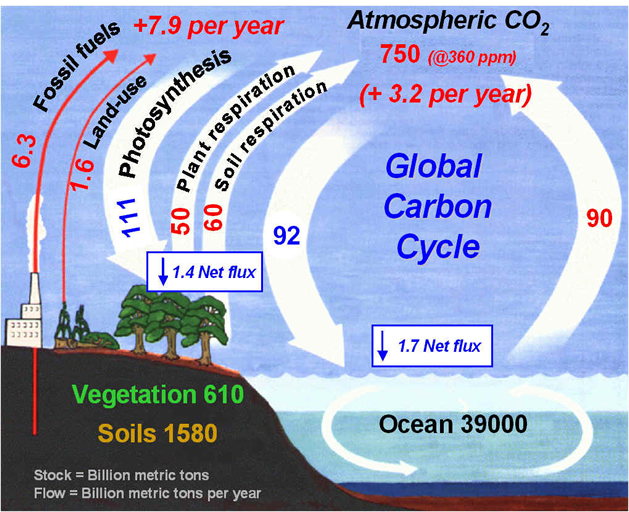
So, where do we need to look? The carbon cycle is a good place to start. The cycle gives us an indication of where everything goes, where everything is transformed, absorbed and so on. A closer analysis of this cycle gives us an idea of where exactly we are influencing the cycle. The main problem isn't really how much CO2 we emit, but how much of the CO2 emitted by us is excess. In other words, how much of it doesn't follow the cycle and simply accumulates. This really is the only CO2 that needs to be controlled as this is the main reason for global warming.
The carbon cycle indicates that on average, in modern day terms, the atmosphere has an excess of about 3.2 billion tons of carbon that it can not flow to other areas. If you click here you have an idea of what sort of flows exist. Now the ocean as we all know plays a huge part in absorbing most of what we emit into the atmosphere, and in fact has been one of the mains reasons why the world has not warmed up faster. Most of us don't know how important it trully is and yet we make no effort to protect it or maintain it. It in fact holds a major role in our future. Marine life absorbs so much CO2 that if we invest money into protecting the marine mangrove forests and actually plan to expand them, more and more CO2 may be absorbed naturally in the carbon cycle giving us more time to breathe and come up with alternate solutions to calm down the environment.
Thursday, October 15, 2009
Wind offshore in the east...why not the west?
Recent developments in offshore wind harvesting in eastern states reaching from North Carolina to Maine has inadvertently moved focus towards our west coast which has just as much if not more windpower offshore.
So why is there little interest in western states such as California in obtaining energy from its strong off shore winds? One answer is its topography offshore. Unlike eastern states which have a fairly continuous continental shelf on which turbines can be anchored, the west coast has a sudden shear drop to depths that do not allow turbines to be anchored with today's technology at an economic rate. Another reason is that California has large tracts of land that is recently being developed to obtain wind energy with less expense. With plenty of land to last them economically there is no need at the time to develop offshore wind systems. Power prices as well are cheaper than those in states such as New England and therefore there is little incentive to dump large amounts of money into new technologies as offshore wind when they are already stable. These technologies would have to deal with such things as the tremendous depths that the wind turbines would have to be anchored as well as earthquakes which the area is prone to. Other concerns in developing this technology include the high price for the research and engineering as well as maintenance.
From these reasons I believe it an understandable position of western states to resist the drive toward offshore wind power to some degree. I see it as beneficial however for small divisions of field research to develop basic groundwork. The potential for states such as California to establish this technology to produce electricity will come as a gain as it can produce enough for itself and for other grid systems in the long run. And as in the case of Texas which is proving to be a founder in the innovations of solar and nuclear plants California can also prove to be a key to such technologies as offshore wind technologies and gain world attention.
Citation: Galbraith, Kate. "Prospects Distant for Offshore Wind in West - Green Inc. Blog - NYTimes.com." Energy and Green Business - Green Inc. Blog - NYTimes.com. 09 Oct. 2009. Web. 15 Oct. 2009..
So why is there little interest in western states such as California in obtaining energy from its strong off shore winds? One answer is its topography offshore. Unlike eastern states which have a fairly continuous continental shelf on which turbines can be anchored, the west coast has a sudden shear drop to depths that do not allow turbines to be anchored with today's technology at an economic rate. Another reason is that California has large tracts of land that is recently being developed to obtain wind energy with less expense. With plenty of land to last them economically there is no need at the time to develop offshore wind systems. Power prices as well are cheaper than those in states such as New England and therefore there is little incentive to dump large amounts of money into new technologies as offshore wind when they are already stable. These technologies would have to deal with such things as the tremendous depths that the wind turbines would have to be anchored as well as earthquakes which the area is prone to. Other concerns in developing this technology include the high price for the research and engineering as well as maintenance.
From these reasons I believe it an understandable position of western states to resist the drive toward offshore wind power to some degree. I see it as beneficial however for small divisions of field research to develop basic groundwork. The potential for states such as California to establish this technology to produce electricity will come as a gain as it can produce enough for itself and for other grid systems in the long run. And as in the case of Texas which is proving to be a founder in the innovations of solar and nuclear plants California can also prove to be a key to such technologies as offshore wind technologies and gain world attention.
Citation: Galbraith, Kate. "Prospects Distant for Offshore Wind in West - Green Inc. Blog - NYTimes.com." Energy and Green Business - Green Inc. Blog - NYTimes.com. 09 Oct. 2009. Web. 15 Oct. 2009.
Wednesday, October 14, 2009
Solar Living, Without Compromising on Lifestyle
Twenty teams of university students from the United States, Canada, and Europe are going head to head in the Solar Decathlon, a federal Department of Energy competition. Their challenged is to construct and design a solar powered home. The 10 day competition will consist with a series of test that should prove their solar powered home to be livable. They will also be judged on the "architect design, engineering skill and comfort."
I like the fact that this competition exists because it gives students a chance to showcase their skills but also their great ideas. One will never know if any of these students will come up with an invention or idea that we will be using in the future. With success, these students can prove that there is a way to live a "green" life in your own home.
I like the fact that this competition exists because it gives students a chance to showcase their skills but also their great ideas. One will never know if any of these students will come up with an invention or idea that we will be using in the future. With success, these students can prove that there is a way to live a "green" life in your own home.
Climate: a bipartisan problem that needs a bipartisan solution
As we know, global warming is not just a mundane myth, is is increasingly becoming a global reality and unless we do something to curb our effect on the environment now, we're going to see something close to an environmental rapture in the years to come. It seems like after quite sometime, the senate democrats seem to have gotten the message. Although previously, key democrats were strictly opposed to the Nuclear option - fearing it was unstable, radio-toxic and would only create more environmental problems - have recently decided to support the nuclear option - if it means more republicans will sign onto the climate bill.
Notably, senator Kerry who has been known for his long-time support for climate legislation said "We're going to work in a bona fide way with everybody to see how to bridge a gap here. We've got to get a 60-vote margin. That means you've got to legislate, which means you have to compromise."
The current legislation being debated includes a "preliminary section on nuclear power that provides greater incentives for worker training and research, as well as funding for the NRC's program to study the feasability...of expanding comercial reactor use beyond their current 40-year licenses"
How has the NRC responded? They believe it's a "step in the right direction" however more comprehensive nuclear reform will be needed to revitalize the industry.
The democrat's decision to barter with the republicans and make concessions is both monumental and proactive, especially at a time where there is such a great schism in congress over the healthcare bill. The Kerry-Boxer proposal is not just "a step in the right direction" it makes the necessary compromises that are at the heart of popular legislation, and potentially the signal of a new-wave of bipartisanship to come.
-Shikhar
Monday, October 12, 2009
The Financial Crisis' impact on CO2 Emissions
Summary: In the IEA’s World Energy Outlook 2009 Climate Change Excerpt released last week, the IEA found that the ongoing financial crisis has had a significant impact on worldwide CO2 emissions, predicting a fall in CO2 emissions of as much as 3% which would be the greatest drop in 40 years. IEA Executive Director Nobuo Tanaka goes on to explain how “this gives us a chance to make real progress towards a clean-energy future, but only if the right policies are put in place promptly.”
Comment: The impact the financial crisis has had on worldwide CO2 emissions has been huge. At first, a fall of 3% from the previous year may not seem like much, but when you consider the fact that the worldwide CO2 emissions for the last decade has increased on average by about 3% annually, a fall of 3% becomes a huge deal. In fact, the press release even states that the predicted CO2 emissions in 2020 is now 5% lower than it was calculated to be last year, and that’s without any changes in climate change policies.
The drop in CO2 emissions this year will not solve the climate change issue, but it will be a small break if, and only if, we capitalize on it and work towards the goals of the IEA’s 450 ppm Scenario (“to stabilize the concentration of greenhouse-gas emissions in the atmosphere at 450 ppm CO2-equivalent.” At these levels, the average global temperature would be within the 2 degrees Celsius margin for dangerous global warming). In the press release, Dr. Tanaka stresses the importance of a worldwide energy transformation, especially by the two major contributors of CO2 emissions, China and the United States.
The financial crisis has provided us with a little relief, but we, as a world, need to use it as a window of opportunity to get on track towards the 450 ppm Scenario. Hopefully, the world will take swift action and come to an agreement when the UN Framework Convenction on Climate Change meets at Copenhagen in December.
Sunday, October 11, 2009
The Power of Green
Tom Friedman, author of “The Power of Green,” describes his ideas of green patriotism with his motto: “Green is the new red, white and blue.” The term green is slowly transforming from “tree-hugging” and “girly” to being considered geoeconomic and environment-friendly. This ideology could be the binding tool to revive America’s patriotism. The United States has made steps toward uniting after the 9/11 tragedy but a common interest or goal could help quicken the process.
Americans are continuously bombarded with issues regarding global warming, the economy and terrorism, and the solution of creating a green nation can be the beginning of a consolidating political movement. Painting the states green could erase over the divisions and differences of the red and blue states and transform the image of the US into one single hue and could drive us forward.
Tom Friedman believes that the highway system that President Eisenhower installed after the Communist threat helped America’s car culture grow and aided to our dependence of oil. Because of this “red menace” we have to pay for our reliance on harmful fossil fuels and the economic and environmental prices that came along with the habit.
We are in desperate need of a leader who can address the “profound economic, geopolitical and climate threats posed by our addiction to oil” (Friedman). By making more efficient ways of producing energy we can regain our “international stature” by leading the way in fueling our nation in a much cleaner way with alternative energy. These changes are in hopes that many countries will follow the example.
Subscribe to:
Posts (Atom)